If you ask ten consciousness researchers where in the brain consciousness actually happens, you will get at least five different answers — and a friendly argument. This isn't because neuroscientists are careless. It's because "consciousness" itself is hard to pin down, and every major theory starts from a different idea of what needs explaining, which leads it to a different part of the brain.
This article is a guided tour of the leading theories and the specific brain structures each one nominates as the seat — or at least the engine room — of conscious experience. Think of it as a map of the debate, not a verdict. Nobody has delivered a verdict yet.
A quick note on vocabulary: researchers often talk about the neural correlates of consciousness (NCC) — the minimal set of brain activity that reliably goes with having an experience, as opposed to processing the same information unconsciously. Almost every theory below is, at heart, a claim about what the NCC actually is.
1. Global Workspace Theory: the prefrontal–parietal "broadcast" network
The core idea: Most of what your brain does happens in the dark, so to speak — in specialized modules that never reach awareness. Global Workspace Theory (GWT), originally proposed by psychologist Bernard Baars and later given a detailed neural mechanism by neuroscientist Stanislas Dehaene and colleagues as the Global Neuronal Workspace (GNW), argues that information becomes conscious precisely when it gets broadcast widely enough that many different brain systems — memory, language, planning, motor control — can all use it at once. Unconscious processing is local and siloed; conscious processing is shared.
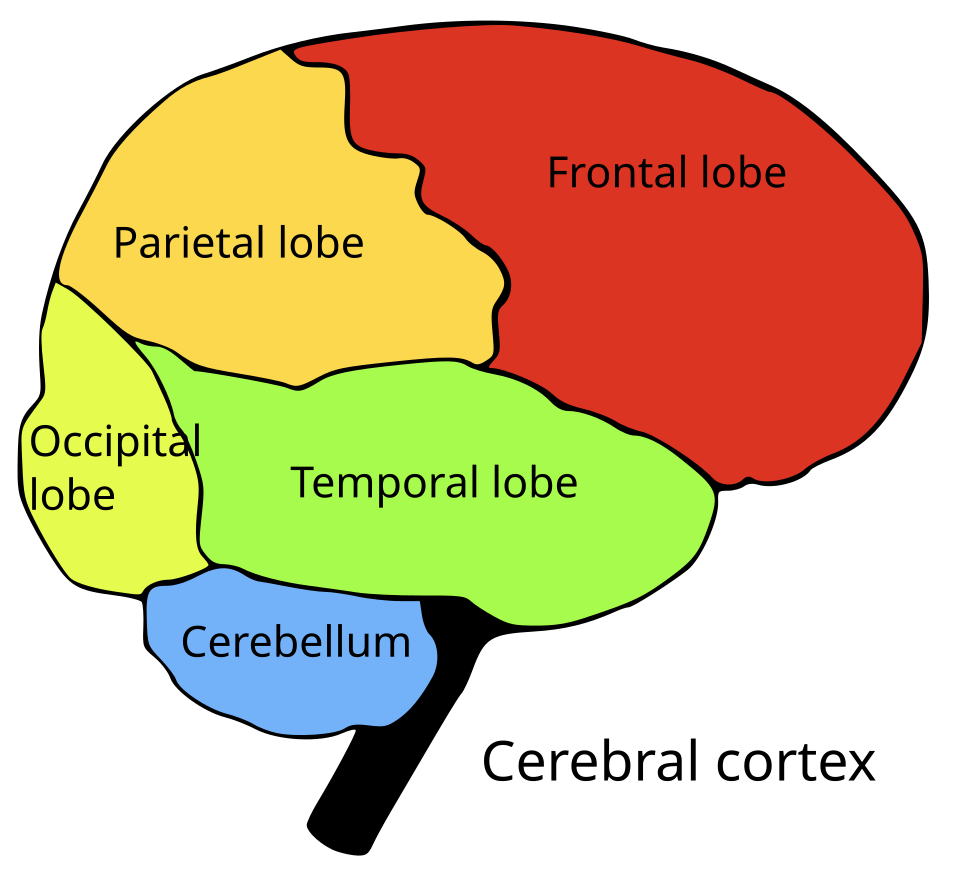
The proposed structure: A network of long-range neurons, concentrated in the prefrontal cortex (behind your forehead) and parietal cortex (toward the crown and back of your head), along with the anterior cingulate cortex. These regions are unusually rich in neurons with long axons that can send signals over long distances, making them well-suited to act as a broadcasting hub that links up otherwise separate processing areas.
The signature event: GNW predicts a specific, fast, nonlinear jump in brain activity called "ignition" — when a stimulus crosses the threshold into awareness, activity suddenly surges and spreads into frontoparietal cortex, rather than fading out the way unconscious signals do. In EEG recordings, this often shows up as a late brainwave called the P3b wave, arriving a few hundred milliseconds after a stimulus.
2. Integrated Information Theory: the posterior "hot zone"
The core idea: Integrated Information Theory (IIT), developed by neuroscientist Giulio Tononi, takes a very different starting point. Instead of asking "which brain regions talk to conscious content?", it starts from the felt qualities of experience itself — that it's unified, specific, and can't be broken into independent parts — and asks what kind of physical system could produce that. IIT's answer: a system is conscious to the degree that it has a high amount of integrated information, usually denoted with the Greek letter Φ (phi) — information generated by the whole system that can't be reduced to, or predicted from, its separate parts.
The proposed structure: IIT does not point to the front of the brain at all. Instead, it locates the likely seat of consciousness in a posterior "hot zone" — a region spanning the temporal, parietal, and occipital cortex at the back and sides of the brain. This zone is thought to have the dense, richly interconnected wiring needed to generate high Φ. Notably, IIT predicts that the prefrontal cortex is not required for conscious experience itself, even though it's clearly involved in things like reasoning about, reporting, or deliberately thinking about that experience.
A caveat worth knowing: IIT has become the most philosophically and scientifically contested theory on this list. Its architecture implies, in principle, that even simple systems with the right kind of connectivity (in theory, even certain non-biological circuits) could have some degree of consciousness — a claim critics call "anti-common-sense." In 2023, a group of over 100 consciousness researchers signed an open letter arguing IIT should be labeled pseudoscience, prompting a very public and still-unresolved dispute within the field about what does and doesn't count as testable science. IIT's defenders — including neuroscientist Christof Koch — maintain that it is simply a theory that could turn out to be wrong, which is different from being unscientific.
3. Higher-Order Theories: prefrontal cortex, again — but for a different reason
The core idea: Higher-Order Theories (HOTs), associated with philosopher David Rosenthal and neuroscientist Hakwan Lau among others, propose that having a sensory representation isn't enough to be conscious of it — the brain also needs a kind of representation about that representation. In plain terms: you don't just need to see red, your brain needs something like an internal registration that "I am seeing red." Without that second, "higher-order" layer, the first-order sensory signal stays unconscious, even if it's influencing your behavior.
The proposed structure: Specific subregions of the prefrontal cortex, particularly the dorsolateral prefrontal cortex and the frontopolar cortex (the very front tip of the frontal lobe). In this model, first-order sensory representations arise in the usual sensory areas (visual cortex, auditory cortex, etc.), but they only become conscious once they're monitored or represented by this prefrontal network.
How it differs from Global Workspace Theory: Both HOTs and GWT put the prefrontal cortex in a starring role, but for different reasons. GWT says the prefrontal cortex matters because it broadcasts information widely; HOTs say it matters because it generates a self-directed, monitoring representation. This is a subtle but important distinction, and it leads to different experimental predictions about exactly what prefrontal damage or stimulation should do to awareness.
4. Recurrent Processing Theory: feedback loops in sensory cortex itself
The core idea: Neuroscientist Victor Lamme argues that consciousness doesn't require any grand, brain-wide broadcast at all. When your eyes take in a scene, information first sweeps forward through the visual system in a quick "feedforward sweep" — but at this stage, Lamme argues, you're not yet conscious of it, even though your brain may already be reacting to it. Awareness only kicks in when signals loop back — recurrent or "re-entrant" processing — creating a sustained back-and-forth between higher and lower areas.
The proposed structure: This theory keeps things close to the sensory cortex itself. For vision, that means local recurrent loops within the visual cortex (the occipital lobe at the back of the brain), particularly between early visual areas (like V1) and higher visual areas along the ventral stream. Lamme draws a further distinction: this local recurrent activity is enough for basic phenomenal awareness (there being "something it's like" to see), while wider recurrent loops reaching into frontoparietal cortex are needed for access consciousness — being able to report on or reason about what you saw.
Why this matters: Recurrent Processing Theory is one of the few major theories that allows for the controversial possibility that you could be phenomenally aware of something without being able to report it — a gap between "experiencing" and "knowing that you're experiencing" that shows up in some visual-masking experiments.
5. Thalamocortical and "Dynamic Core" theories: the thalamus as a hub
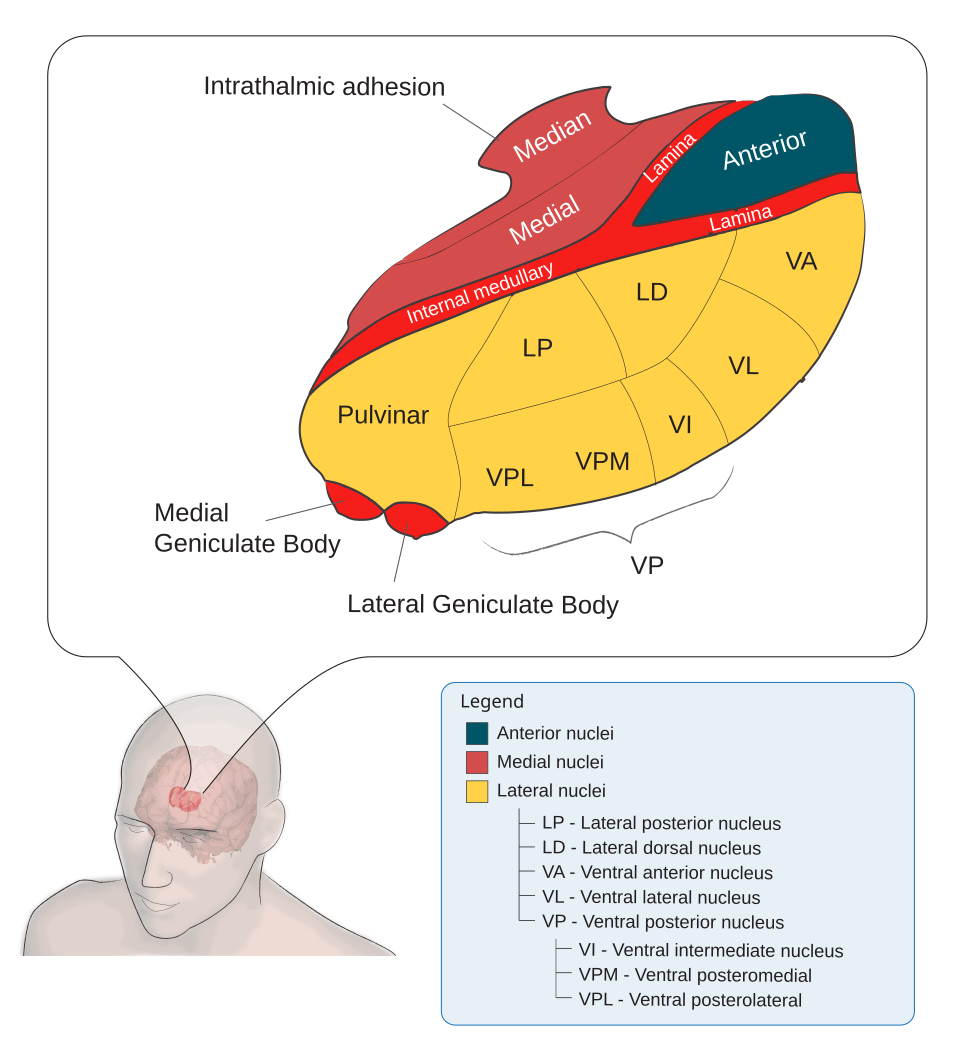
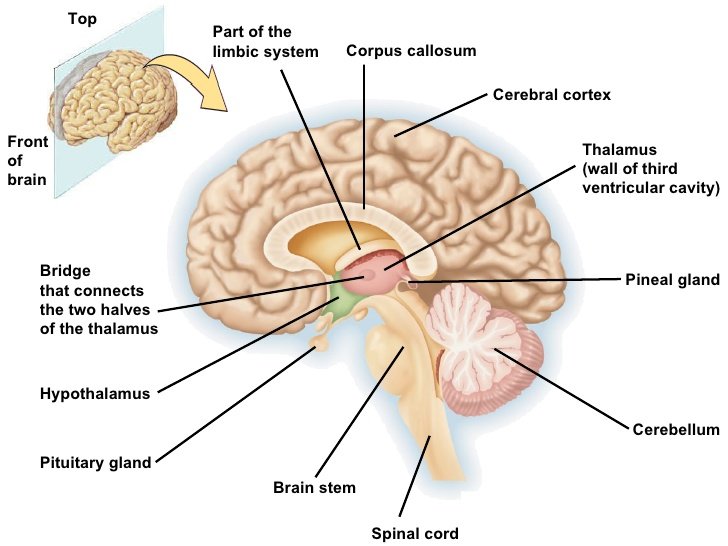
The core idea: Several theories, including the late neurobiologist Gerald Edelman and Giulio Tononi's early Dynamic Core Hypothesis, along with proposals by Rodolfo Llínas and others, argue that the story of consciousness can't be told about the cortex alone — you have to include the thalamus, a small, egg-shaped structure buried deep in the middle of the brain that relays and coordinates almost all sensory and cortical traffic.
The proposed structure: A thalamocortical loop — the constant back-and-forth signaling between the thalamus and the cortex — rather than any single region. This is supported by clinical observations: damage to the thalamus is a common feature in patients in a vegetative state, and general anesthetics reliably disrupt thalamocortical communication. Some versions go further, proposing that fast, synchronized electrical rhythms (in the gamma range, around 40 Hz) moving through thalamocortical circuits act as a kind of "binding" mechanism that ties together the different features of an experience — color, shape, motion — into one unified percept.
Related idea — the claustrum: A thin, sheet-like structure tucked beneath the cortex called the claustrum has also drawn attention, partly because of a single striking case report in which stimulating a patient's claustrum appeared to switch off awareness reversibly. It's densely and widely connected to nearly all of cortex, leading some (including Francis Crick, in one of his last papers) to speculate it might act as a kind of "conductor" that synchronizes cortical activity into a single unified experience — though this idea remains speculative and far less developed than the theories above.
6. Predictive Processing / Free Energy accounts: the whole brain as a prediction machine
The core idea: Rather than looking for a specific "consciousness center," predictive processing theories — associated with neuroscientists like Karl Friston and philosophers like Andy Clark and Anil Seth — start from the idea that the brain's basic job, everywhere, is to constantly generate predictions about incoming sensory data and update itself based on prediction errors. On this view, conscious experience is best understood as the brain's "best guess" — its controlled hallucination — about the causes of its sensory input, continuously corrected by real-world feedback.
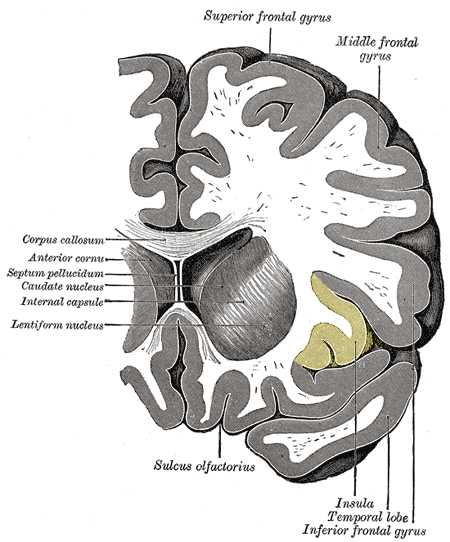
The proposed structure: This is less about one location and more about a pattern of computation repeated in hierarchical loops throughout the cortex, where higher areas send predictions down and lower areas send error signals up. That said, versions of this view (such as Seth's) often emphasize interoceptive predictions — the brain's model of the body's internal state — pointing to structures like the insular cortex and anterior cingulate cortex, which are heavily involved in monitoring heartbeat, breathing, and other bodily signals. This gives predictive processing accounts a distinctive angle: they connect consciousness closely to selfhood and the feeling of being an embodied organism, not just to perceiving the outside world.
7. Attention Schema Theory: a model of attention itself, in the temporoparietal cortex
The core idea: Neuroscientist Michael Graziano proposes that the brain constructs a simplified internal model of its own attention — a bit like how the brain builds a simplified model of the body (a "body schema") to help control movement. According to Attention Schema Theory (AST), our sense of having a subjective experience is essentially the output of this internal model: the brain represents itself as "having" awareness, in the same way it represents itself as having a body, and that internal representation is what we call consciousness.
The proposed structure: AST points especially to the temporoparietal junction (TPJ) and surrounding regions in the posterior parietal cortex, areas well known for their role in tracking attention and reasoning about other people's mental states (an ability psychologists call "theory of mind"). Damage to this region can produce hemispatial neglect, where patients lose awareness of one side of space — a clue AST proponents cite as consistent with a damaged attention-model.
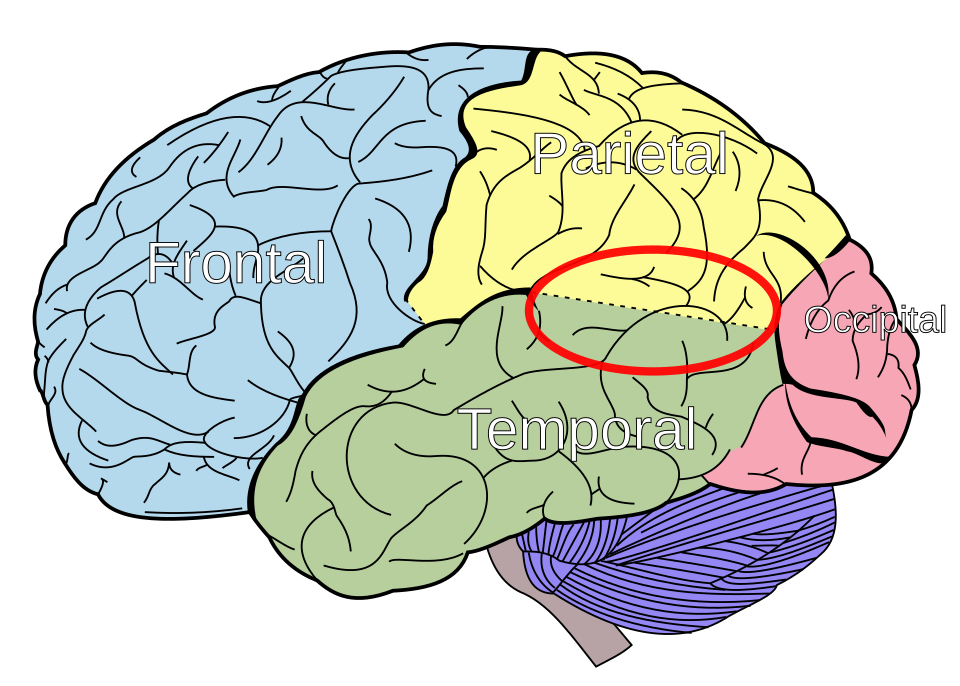
8. A more speculative outlier: Orchestrated Objective Reduction (Orch-OR)
The core idea: Physicist Roger Penrose and anesthesiologist Stuart Hameroff have proposed a very different kind of theory, arguing that classical neuroscience — neurons, synapses, firing rates — cannot in principle explain subjective experience, and that consciousness instead arises from quantum-mechanical processes.
The proposed structure: Microtubules — tiny protein scaffolding structures inside neurons, part of the cell's internal skeleton — are proposed to support quantum computations that, when they "collapse" in an orchestrated way, generate moments of conscious experience.
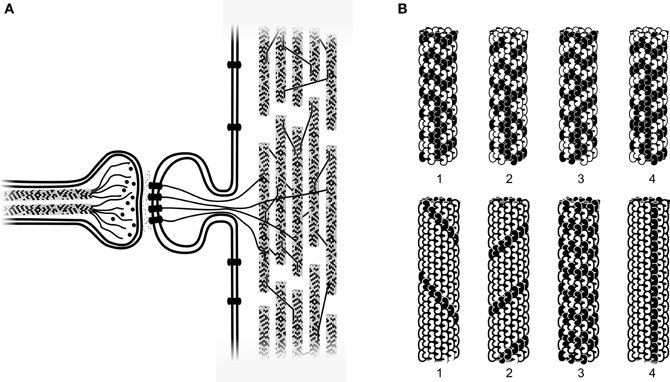
Why it's usually set apart: Orch-OR sits well outside mainstream consciousness neuroscience. It faces serious physical objections — most notably that the warm, wet, noisy environment inside a living brain is thought to be extremely hostile to preserving delicate quantum states long enough for them to matter. Most consciousness researchers treat it as a minority position, but it's included here because it's well known publicly and illustrates just how wide the range of serious proposals really is — from "which cortical network" all the way to "which physical process at the subatomic scale."
So which one is right? The state of the evidence
As of the most recent major test, we genuinely don't know — and that uncertainty is itself an important, hard-won result.
In 2023, an unusual project called the Cogitate Consortium ran a large, pre-registered "adversarial collaboration": researchers who championed Global Neuronal Workspace Theory and researchers who championed Integrated Information Theory agreed in advance on a shared experiment and on what result would count as support for, or against, each of their theories — combining fMRI, EEG, and intracranial recordings across more than 250 participants. This kind of head-to-head, both-sides-agree-on-the-test design is rare in consciousness science and was itself considered a methodological breakthrough.
The result, published in Nature, was a genuine split decision. The data showed sustained activity in the posterior "hot zone," as IIT had predicted — but it did not show the sharp, sustained synchronization within posterior cortex that IIT also predicted. Meanwhile, GNW's prediction of a late "ignition" got some support, but the theory's expectation of strong, sustained representation in prefrontal cortex was not clearly borne out either. In short: both theories were partly right, and both were partly wrong. Neither camp could claim victory, and both had to publicly acknowledge results that didn't fit their model.
That outcome, awkward as it was for both sides, is arguably a sign of a maturing field: theories are now specific enough to make different predictions, and researchers are willing to test those predictions in ways that could actually prove them wrong. The still-unresolved dispute over whether IIT even counts as testable science shows the field hasn't settled its foundational disagreements — but the fact that large, competing labs can now run a shared experiment and report a mixed, honest result is new, and it's a genuinely encouraging sign for where the science is heading.
The honest summary
| Theory | Key brain structure(s) proposed |
|---|---|
| Global Workspace / Global Neuronal Workspace | Prefrontal cortex + parietal cortex (broadcasting network) |
| Integrated Information Theory | Posterior "hot zone" — temporal, parietal, occipital cortex |
| Higher-Order Theories | Prefrontal cortex (dorsolateral and frontopolar regions) |
| Recurrent Processing Theory | Local feedback loops within sensory (e.g., visual) cortex |
| Thalamocortical / Dynamic Core theories | Thalamus and its looping connections with cortex; claustrum in related proposals |
| Predictive Processing / Free Energy | Hierarchical cortical loops broadly; insula and anterior cingulate for body-based predictions |
| Attention Schema Theory | Temporoparietal junction and posterior parietal cortex |
| Orchestrated Objective Reduction (Orch-OR) | Microtubules inside neurons (subcellular, not a brain region) |
No single structure on this list has been ruled in as the definitive seat of consciousness, and none has been fully ruled out either. What's changed in the last few years isn't a winner emerging — it's that the field has developed sharper tools, more rigorous shared experiments, and a much clearer sense of exactly where these theories agree, disagree, and can be tested against one another. That, more than any single finding, is the real headline of current consciousness research.
References and further reading:
Baars, B.J. — Global Workspace Theory; overview: Baars, Geld & Kozma (2021). Dehaene, S. & colleagues — Global Neuronal Workspace: Mashour, Roelfsema, Changeux & Dehaene (2020)
Tononi, G. et al. — Integrated Information Theory, latest formal version IIT 4.0 (Albantakis et al., 2023)
Lau, H. & Rosenthal, D. — "Empirical support for higher-order theories of conscious awareness," Trends in Cognitive Sciences (2011)
Lamme, V.A.F. — Recurrent Processing Theory (2006)
Edelman, G. & Tononi, G. — A Universe of Consciousness (2000), building on Tononi & Edelman (1998); Ward, L.M. — "The thalamic dynamic core theory of conscious experience" (2011)
Friston, K. — "The free-energy principle: a unified brain theory?" (2010); Seth, A.K. — "Interoceptive inference, emotion, and the embodied self" (2013)
Graziano, M.S.A. — Attention Schema Theory (2013); mechanistic account: Graziano & Webb (2015)
Penrose, R. & Hameroff, S. — "Consciousness in the universe: A review of the 'Orch OR' theory" (2014)
Cogitate Consortium — "Adversarial testing of global neuronal workspace and integrated information theories of consciousness," Nature (2025)
Fleming, S.M. et al. — Open letter, "The Integrated Information Theory of Consciousness as Pseudoscience" (2023)