Original Theory
Consciousness as a
Measurement Problem
Perception, Reference, and the Physical Basis of Experience
Nandakumar Sasidharan Rajalekshmi · Zürich · 2024–2025
Abstract
Consciousness — our capacity to perceive — can be understood fundamentally as an act of measurement. Every valid measurement depends on two things: an energy transfer between the observer and the observed, and an invariant zero-reference level against which that transfer is registered. Because measurement must remain valid across any distance in the universe, this reasoning points to a ubiquitous, invariant reference level — a universal ground zero — as the source of perception itself. As part of every measurement, the perceiving subject absorbs a quantum of energy, producing an internal structural change that we experience subjectively. Where thought and imagination have traditionally been treated as the defining markers of consciousness — leading to the view that consciousness is an emergent property of the brain — this model suggests instead that consciousness is universal, that it drives evolution, and that structures such as the brain are a byproduct of that process rather than its origin.
Conceptual Map
The Measurement Process
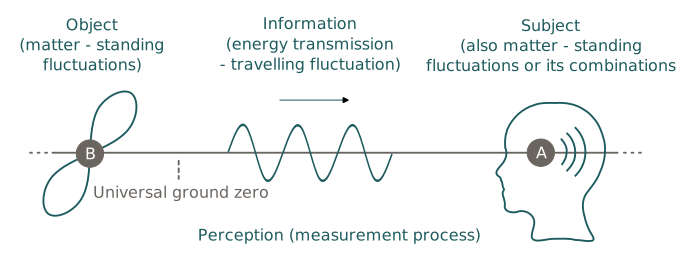
Fig. 1 — For a subject at point A to make a measurement about an object at point B, an energy transmission must pass between the two, and an invariant reference level must hold at A, at B, and throughout the traveling wave. Since A and B can be any two points in the universe, this reference level must itself be everywhere — the universal ground zero. Because this reference level underlies every measurement, we identify it as the basis of consciousness.
Core Propositions
Six Foundational Claims
Proposition I
Consciousness as the Capacity to Perceive
Experience, memory, and response are secondary effects of a single prior capacity: the ability to perceive. Redefining consciousness as the capacity to perceive reframes the question from "why are we conscious?" to the more tractable "why do we perceive?" — and shifts the inquiry from the architecture of the brain to the physical requirements of perception itself.
Reframes: Chalmers' "hard problem" of consciousness · the objective/subjective divide in consciousness research.
Proposition II
Perception as Measurement: The Need for a Common Reference
Physically, perception is a measurement — and every measurement has two requirements: an energy transfer between the measuring point and the measured point, and a zero-reference level against which that transfer registers. For the measurement to stay accurate across any distance, this reference level must remain invariant at both points and throughout the transfer between them.
Scientific parallel: Signal detection theory · the need for a fixed baseline before any physical observation is possible.
Proposition III
The Universal Ground Zero
Because any two points in the universe must share an invariant reference level to measure one another, that reference level must itself be everywhere — a universal ground zero. As this baseline underlies every measurement, it is proposed here as the basis of consciousness itself, rather than an axiom assumed at the outset.
Scientific parallel: The vacuum state in quantum field theory, against which every particle, wave, and force is measured as a departure from a lowest-energy baseline.
Proposition IV
A Common Platform for Communication
Two entities can only communicate through a shared medium — two brains translate thought into sound waves carried by air; two atoms interact through the fields between them. Extending this reasoning down to the most fundamental particles, with no further intermediary available, suggests that a particle exists as a stable fluctuation on the ground-zero level itself — and that each higher layer of structure is a stable pattern resting on the layer beneath it, much like a knot standing out against the rope it is tied from.
Scientific parallel: Particles and radiation as excitations of an underlying field in quantum field theory.
Proposition V
The Reference Level Drives Evolution
When we perceive a distant star, the same ground-zero reference connects the particles of our neurons, the light waves in transit, and the particles of the star — the difference is only in how far each has evolved, and how much memory and capacity to respond each carries. Evolution, on this view, is the unfolding of increasingly complex structure enabled by this shared, common reference.
Scientific parallel: Hierarchical emergence of complexity, from subatomic particles to planets and stars.
Proposition VI
The Origin of Experience
Matter and waves exist as stable, cyclical fluctuations on the ground-zero reference, layered from subatomic particles up through planets, stars, and living bodies. When a person perceives something, they intercept a traveling wave and absorb a quantum of energy — this additional energy alters their physical state, and that structural modification is what we call experience. Experience is therefore a byproduct of consciousness, not consciousness itself; and the accumulation of such modifications, over different timescales, is what we call learning, growth, or evolution.
Scientific parallel: Structural/synaptic change as the physical substrate of memory formation.
If consciousness is unified at the level of this ground reference, why does experience feel individual? Evolution is not uniform everywhere: as structure grows more complex it becomes fragmented, and each fragment communicates by translating its state down to a shared lower layer — sound, light, or an electric signal — rather than by directly touching the unity beneath it. Individuality, on this view, is a feature of structural complexity, not a break from the underlying reference.
A Consequence of the Model
Reframing Unconsciousness
If consciousness is tied to a universal reference level, unconsciousness cannot be a removal of that reference — no chemical agent can switch off something ubiquitous. What sleep, anesthesia, or injury actually disrupt is the process of measurement within the nervous system: either the message itself is altered en route, or the pathway carrying it is broken before it arrives.
This distinction has empirical support. In one study of healthy volunteers under deep general anesthesia, measurable brain and spinal-cord responses to painful stimulation persisted even at drug doses high enough to fully suppress outward clinical signs such as movement or a change in heart rate. The model proposed here reads this as consistent evidence: the signal keeps traveling and registering somewhere in the system, but its content, or its route to its usual destination, has been altered rather than switched off.
Scientific Dialogue
In Dialogue with Other Theories
Consciousness research has long divided into two camps: those treating experience as emergent from brain complexity, and those treating it as fundamental to matter itself. This model starts one step earlier than either — from the physical requirements of a valid measurement — rather than from the organisation of information inside a brain.
Global Neuronal Workspace Theory
GNWT holds that a thought becomes conscious only once it is broadcast widely across the brain, chiefly via frontal regions — like a notice posted where everyone can read it. This model instead explains why we don't experience all of memory at once: experience arises only when energy exchange produces a structural change, so a memory enters awareness only when retrieved.
Integrated Information Theory
IIT ties consciousness to how richly a system's parts are interconnected, and — like this model — extends the idea beyond brains. But IIT measures how much a system qualifies without explaining why meeting that measure brings any experience at all. Here, consciousness is fundamental regardless of structure; structural complexity marks depth of memory, not the presence of experience itself.
Panpsychism & Philosophy of Mind
Thinkers from Russell to Strawson, Goff, and Chalmers have argued that experience must be a basic feature of reality, since it could not emerge from wholly non-experiential ingredients. This model arrives at a similar universality, but by a physical route — the shared reference point and energy exchange required for any two things to interact — rather than as a starting philosophical axiom.
Orchestrated Objective Reduction
Penrose and Hameroff locate consciousness in delicate quantum events inside specific structures found so far only in certain brain cells. This model makes no such structural assumption: it relies only on the established requirements for measurement — a shared reference and an energy exchange — which apply wherever energy is exchanged, not to one privileged biological structure.
An Open Inquiry
This model traces both consciousness and experience to specific, physical requirements, offering a path toward a universal consciousness grounded in physics rather than assumed as a starting axiom. It remains a living document, open to revision and dialogue. I welcome engagement from physicists, neuroscientists, philosophers, and contemplatives.